How long should an online course be? Start with the task
An online course should be long enough for someone to complete the task you promised. There is no single running time that suits every subject. A client preparing for a first call and a new colleague learning a complex process need different amounts of explanation, practice and support.
Updated

In this article
Write the finish line before estimating the time
Begin with a sentence you can observe: “By the end, you will bring a clear goal and the right information to your first coaching session.” That gives you a way to decide what belongs. A history of coaching might be interesting, but it does not necessarily help someone prepare for Tuesday’s call.
Now list what the learner must know, see and do to reach that finish line. You might need an explanation of what the session covers, one example of a useful goal and a short preparation task. Estimate the time for those activities rather than deciding on a target duration and filling it.
Allow for differences in reading speed and for the work after each explanation. A course that takes four minutes to read may ask for another fifteen minutes of useful work.
Give each lesson one clear job
A lesson break is useful when the learner changes tasks, needs to practise or should be able to return to a specific explanation. It is less useful when it simply divides a long document into equal lengths.
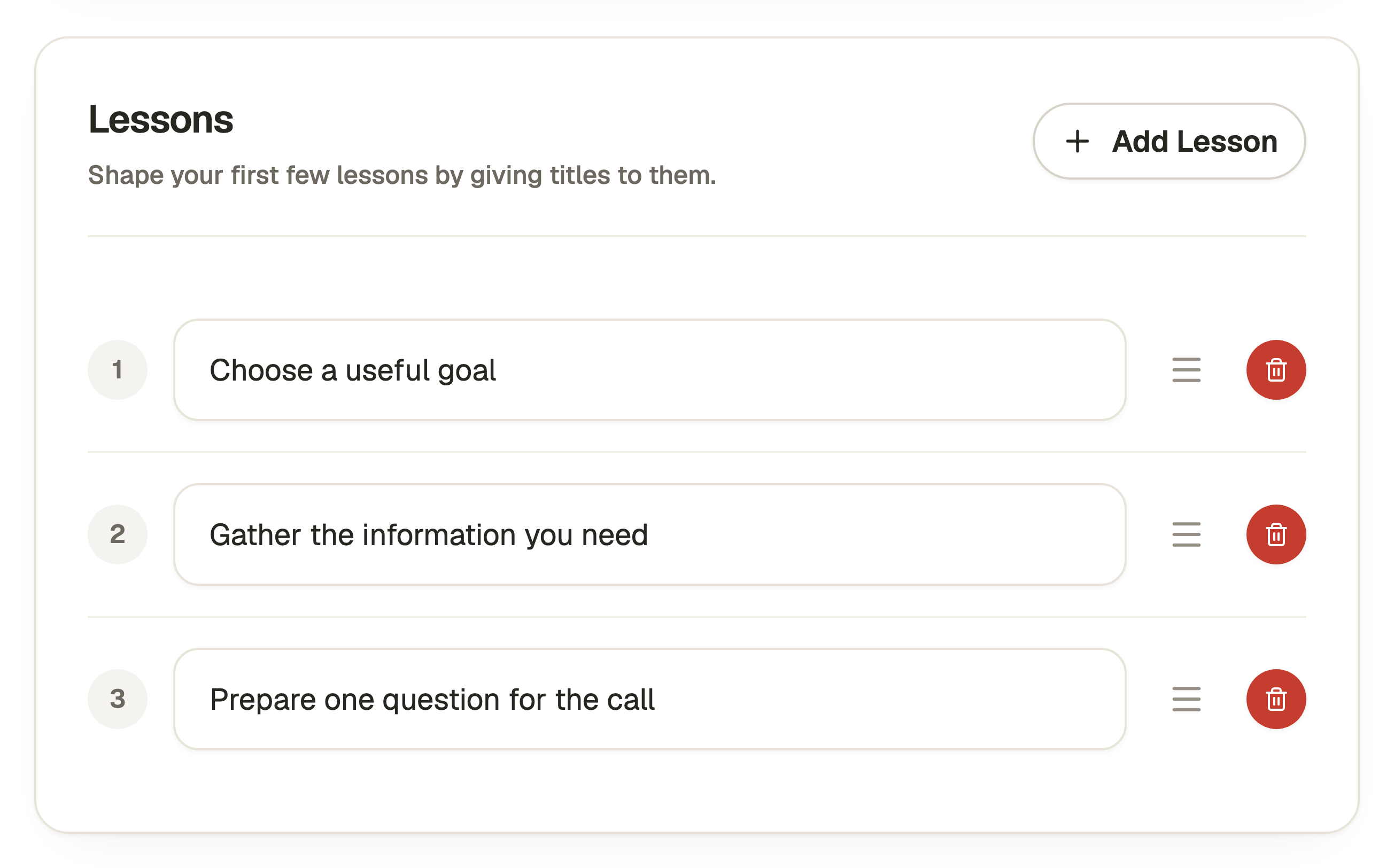
For the coaching example, three lessons could work: choose a useful goal, collect the information that will inform the conversation, and prepare one question. Each has a distinct result. If you cannot explain what changes between two lessons, they may belong together.
Budget for the work between paragraphs
Reading an example, making a decision and writing a reflection are different activities. Give the learner a clear instruction and enough context for each. “Reflect on this” is hard to estimate because it does not say what a useful response looks like.
Instead, ask for something bounded: “Write one sentence describing what you want to be different after the session.” Follow it with an example. That tells the learner when to stop and gives you a sensible basis for a time estimate.
Use a Questions block for a decision or written response, Scenarios for a worked explanation, and Downloads for a file they need afterwards. Choose the format that helps the task. Adding every block type will usually make the course longer without making the outcome clearer.
Choose the right text, media and activity blocksCut the material that delays the first useful result
Look for repeated introductions, background the audience already knows and examples that make the same point twice. Keep explanations of unfamiliar terms, the reasoning behind a decision and any prerequisite the learner needs. Keep the detail someone needs to follow the instruction, even if it takes a little longer to read.
A good editing test is to ask what would go wrong if you removed a paragraph. If the learner would make a predictable mistake, keep the explanation or improve its example. If nothing important changes, try taking it out.
Do the same review for images. A readable screenshot of the actual control can replace a vague description. An uncaptioned picture of a laptop is unlikely to save the learner time.
Test the pace with someone in the intended audience
Ask one person to work through the course without you explaining it aloud. Watch where they reread, leave to find missing information or hesitate over a question. Ask what they thought they were supposed to do. Their answer can reveal a missing instruction more clearly than a duration estimate.
Check the course on a phone in Preview. A large screenshot may become a small image on that screen, and a wide table may require extra effort. Test the actual task, including the download or outside link, rather than just scrolling to the end.
Once people use the published course, review progress and question answers in Analytics. A pause is a reason to investigate. It does not by itself prove the course is too long.
Use Analytics to choose a useful revisionSplit a bigger outcome into courses when the jobs are distinct
If the material now covers preparation, the session itself and several weeks of follow-up, you may have more than one useful course. Let each course deliver its own result, then connect them in a flow when the learner needs the larger path.
Use Sequential order for real prerequisites and Free Order when someone can choose what they need. Do not make a learner complete unrelated material just to reach a reference they came for.
Estimate the length after you have a draft, then test it with a reader. Keep the explanation they need and remove the parts they skip because they already know them.
Bring separate courses together into a learning pathKeep reading

How to create an online course without filming videos
A practical way to turn notes, screenshots and a few thoughtful questions into a course, with a three-lesson example to get you started.

Know what is landing with deeper analytics
Look at lesson progress and question answers to decide what needs a clearer explanation, then check whether your changes help.